
Zig Under the Microscope: What 67 Remote AST Tools Found Inside the Self-Hosted Compiler and Standard Library
Historical Zig compiler and standard library analysis with prod-code: source distribution, x86_64 codegen clones, errdefer patterns, and a remote ZLS refactoring example. Zig is now hosted on Codeberg.
On this page · 4 sections
Systems programming languages demand precise compiler behavior. Zig is a general-purpose language and toolchain with comptime execution, explicit error handling, and allocator-based memory management. The project moved from GitHub to Codeberg; its canonical repository is codeberg.org/ziglang/zig.
The self-hosted Zig compiler, code-generation backends, standard library, and tests provide varied inputs for AST parsing, duplicate detection, and refactoring proposals. We used selected operations from prod-code’s 67-tool suite against a Zig checkout identified in the original post as ziglang/zig, with analysis and ZLS diagnostics running remotely. The local client still handles synchronization, requests, and results.
The command excerpts below are historical observations retained from the original publication. No pinned upstream commit or complete measurement environment is recorded here, so counts, paths, line numbers, and scan durations are snapshot-specific and have not been remeasured for this update. The excerpts cover selected operations from the 67-tool suite, not verification of every tool. A cycle-free extracted module graph does not establish all source-level or external dependency relationships; clone counts do not establish runtime performance. Analyzer diagnostics are not a compiler build or test result.
$ git ls-files '*.zig' | wc -l
2950
$ git ls-files -z '*.zig' | xargs -0 wc -l | tail -n 1
1357479 total
$ git ls-files | awk -F. '{if (NF>1) print $NF}' | sort | uniq -c | sort -nr | head -n 6
11492 h
 2950 zig
 2653 def
 2322 c
  216 s
  209 cpp
The captured inventory reports 1,357,479 Zig lines in 2,950 files and 11,492 headers. It does not establish exhaustive semantic coverage or local hardware usage.
Subsystem Architecture, Self-Hosted Compiler, and Standard Library Topology
The Zig repository contains three primary architectural layers: the self-hosted compiler frontend and backend (src/), the batteries-included standard library (lib/std/), and the compiler runtime library (lib/compiler/), along with comprehensive behavior, safety, and linking test suites (test/). Measuring the line distribution across these subsystems reveals the structural balance of the project:
$ for dir in src lib/std lib/compiler test; do
    echo -n "$dir: files="; git ls-files "$dir/*.zig" "$dir/**/*.zig" | wc -l;
    echo -n "$dir: lines="; git ls-files -z "$dir/*.zig" "$dir/**/*.zig" | xargs -0 wc -l | tail -n 1;
  done
src: files=168
src: lines=517489 total
lib/std: files=550
lib/std: lines=435138 total
lib/compiler: files=110
lib/compiler: lines=125865 total
test: files=1492
test: lines=133047 total
The self-hosted compiler core accounts for 517,489 lines across 168 files, encapsulating tokenizer routines, AST generation (AstGen.zig), semantic analysis (Sema.zig), intermediate representations (Air.zig and Lir.zig), register allocation, and machine-code emission. The standard library comprises 435,138 lines across 550 files, providing OS-agnostic IO, memory allocators, hash maps, cryptographic primitives, and formatters.
The build configuration is anchored by build.zig (1,471 lines) and build.zig.zon. We ran prod-code dependencies across the tree to verify package topology:
$ prod-code dependencies
⚡ prod-code Architecture & Dependency Graph Report
────────────────────────────────────────────────────
Scope: modules | Nodes: 2 | Dependencies: 2

✓ Zero circular dependencies detected. Architecture graph is a clean DAG.
The captured dependency scan reports two nodes and no cycles. That limited extraction does not establish a complete compiler or build dependency graph.
Code Generation Clone Groups and x86_64 Instruction Selection Duplication
Instruction selection and machine-code generation frequently require repetitive operand encoding logic across hundreds of assembly opcodes. We ran prod-code duplicates across the repository to locate structural clone groups:
$ prod-code duplicates --path /tmp/zig-eval --min-lines 10
⚡ prod-code Clone & Duplication Harvester Report
────────────────────────────────────────────────────
Files Scanned: 5488 | Lines: 1569444 | Clone Groups: 20 | Duplication: 7.0%

Discovered Clone Groups:

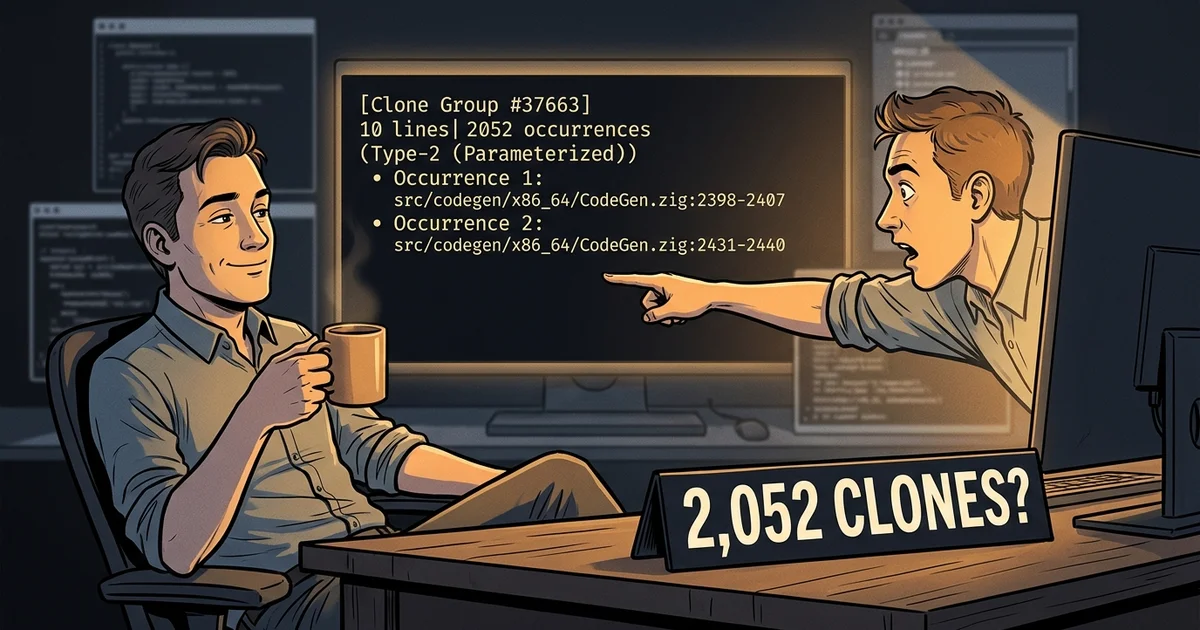
[Clone Group #37663] 10 lines | 2052 occurrences (Type-2 (Parameterized))
  • Occurrence 1: src/codegen/x86_64/CodeGen.zig:2398-2407
  • Occurrence 2: src/codegen/x86_64/CodeGen.zig:2431-2440
  • Occurrence 3: src/codegen/x86_64/CodeGen.zig:2513-2522
  • Occurrence 4: src/codegen/x86_64/CodeGen.zig:2546-2555
  • Occurrence 5: src/codegen/x86_64/CodeGen.zig:2579-2588
  ...
The clone harvester uncovered a massive cluster in src/codegen/x86_64/CodeGen.zig: Clone Group #37663 exhibits 2,052 occurrences of a 10-line Type-2 parameterized pattern. In machine-code generation for the x86_64 backend, lowering instructions involves repetitive register constraint checks, memory operand validation, and immediate bitwidth truncation.
The captured scan reports 7.0% duplication across 1,569,444 lines. Repeated instruction-lowering patterns are visible in the examples, but the report does not measure dispatch overhead or compiler throughput.
Structural AST Patterns: Error Propagation and Deterministic Deferral
Zig uses error union types (!T), try, and scope-based cleanup through defer and errdefer. We deployed prod-code structural-search to inspect how the compiler frontend utilizes these primitives:
$ prod-code structural-search --path src/main.zig 'try $A'
⚡ prod-code Structural AST Search: `try $A`
────────────────────────────────────────────────────
488 match(es) in 1 file(s) (1 scanned in 7612.65ms)

  • src/main.zig:190:18  try process
    └─ [$A = process]
  • src/main.zig:200:25  try fs
    └─ [$A = fs]
  • src/main.zig:233:9   try env_map
    └─ [$A = env_map]
  • src/main.zig:241:35  try arena
    └─ [$A = arena]
  ... and 463 more match(es)
In src/main.zig alone, 488 call sites utilize try $A to propagate CLI parsing, filesystem configuration, and target architecture setup errors without boilerplate conditionals.
Next, we searched across the entire compiler frontend (src/) for Zig’s specialized error-unwinding statement errdefer $A:
$ prod-code structural-search --path src/ 'errdefer $A'
⚡ prod-code Structural AST Search: `errdefer $A`
────────────────────────────────────────────────────
480 match(es) in 56 file(s) (174 scanned in 19675.12ms)

  • src/Air/Liveness.zig:159:5  errdefer gpa
    └─ [$A = gpa]
  • src/Compilation.zig:511:9   errdefer gpa
    └─ [$A = gpa]
  • src/Compilation.zig:1189:17 errdefer {
    └─ [$A = {
            for (file_names.values()) |file_name| gpa.free(file_name);
            file_names.deinit(gpa);
        }]
Across 56 files in src/, the captured search reports 480 errdefer matches. These identify cleanup paths; they do not prove the absence of leaks. Crucially, the structural AST query accurately captured both simple identifier deallocations (errdefer gpa, errdefer arena) and multiline statement blocks with nested iteration, illustrating metavariable extraction on these examples.
Furthermore, defensive programming is enforced systematically throughout the compiler and standard library: an audit of invariant assertions revealed 4,279 assert(...) calls (2,203 in compiler src/ and 2,076 in lib/std/), providing deep runtime self-validation during debug builds.
Remote Semantic Refactoring and Cluster-Backed ZLS Verification
Refactoring systems software requires strict semantic verification: an extracted function must match calling conventions, parameter typing, and return semantics without introducing subtle lifetime or allocation defects.
In lib/std/ascii.zig, the character classification and conversion functions perform bitwise manipulation. In toUpper, the case-conversion mask calculation operates directly on byte values:
pub fn toUpper(c: u8) u8 {
    const mask = @as(u8, @intFromBool(isLower(c))) << 5;
    return c ^ mask;
}
We used prod-code extract-function to isolate the bitmask logic into a dedicated helper caseMask, verifying the proposal with the Zig Language Server (zls 0.16.0) running on our remote cluster:
$ prod-code extract-function --name caseMask --to 187:1 lib/std/ascii.zig 186 5
`fn caseMask` extracted (lib/std/ascii.zig); the selection now reads `const mask = caseMask(c);`
- no other place in the file has the selection's text

--- a/lib/std/ascii.zig
+++ b/lib/std/ascii.zig
@@ -184,4 +184,9 @@
 /// Uppercases the character and returns it as-is if already uppercase or not a letter.
-pub fn toUpper(c: u8) u8 {
+fn caseMask(c: u8) u8 {
     const mask = @as(u8, @intFromBool(isLower(c))) << 5;
+    return mask;
+}
+
+pub fn toUpper(c: u8) u8 {
+        const mask = caseMask(c);
     return c ^ mask;

the analyzer accepts the result: 0 errors

nothing was written; pass `apply: true` to make this edit
The refactoring pipeline recognized primitive scalar types (u8), deduced the parameter type c: u8 and return type u8, synthesized the proper Zig function header fn caseMask(c: u8) u8, and updated the call site to const mask = caseMask(c);. The remote ZLS instance analyzed the generated AST in place and confirmed 0 errors, with diagnostics running remotely. No compiler build, tests, or local CPU measurement is shown.
The captured examples demonstrate selected query and refactoring proposals on Zig syntax. They do not verify every construct or all 67 tools.
Use cleanup counts to find review sites; use compiler builds and tests to assess the proposed changes.
Cite this article
Alexander Panasenko (2026-09-30). Zig Under the Microscope: What 67 Remote AST Tools Found Inside the Self-Hosted Compiler and Standard Library. https://prod.codes/blog/zig-under-the-microscope-67-ast-tools/