
Vibe.d Under the Microscope: What 67 Remote AST Tools Found Inside the D Asynchronous Web Framework
Analysis of the D asynchronous web framework with prod-code: 30,151 lines across 108 files, a two-node dependency extraction with no edges, compile-time REST interface generation, and repository-wide assertion matching lines.
On this page · 4 sections
Before the async/await paradigm became ubiquitous across modern language runtimes, asynchronous server architectures struggled with “callback hell” or heavy thread pool overhead. Vibe.d solved this in the D ecosystem by coupling an event-driven I/O loop (epoll, kqueue, libevent) with lightweight cooperative fibers (coroutines).
In Vibe.d, network code reads like straightforward synchronous procedural code, yet any blocking socket read or write automatically yields the calling fiber back to the event loop, achieving tens of thousands of concurrent connections on a single OS thread. Moreover, Vibe.d leveraged D’s compile-time metaprogramming to introduce declarative REST interfaces, where ordinary D interface types automatically generate both HTTP server endpoints and strongly typed client proxies without runtime reflection.
To inspect how Vibe.d organizes its fiber-based drivers, REST code synthesis, and stream integrity invariants, we deployed operations from prod-code’s 67-tool suite against a Vibe.d checkout (master branch) on a remote 32-core cluster node (192.168.2.143:9400), measuring modular topologies, clone clusters, and AST invariants.
$ git ls-files '*.d' | wc -l
108
$ git ls-files -z '*.d' | xargs -0 wc -l | tail -n 1
30151 total
$ git ls-files | awk -F. '{if (NF>1) print $NF}' | sort | uniq -c | sort -nr | head -n 6
 108 d
  28 json
  10 sh
   5 md
   5 txt
   3 sdl
The captured inventory reports 30,151 lines of D across 108 files. The package breakdown below omits the http/ package, so its subtotals are not an exhaustive partition of the inventory:
- Web & REST Framework (
web/): 8,829 lines across 16 files. - Database Drivers (
mongodb/,redis/): 11,215 lines across 28 files. - Streams, Protocols & Utilities (
utils/,mail/,stream/): 10,107 lines across 64 files.
Subsystem Architecture: Decoupled Concurrency and Protocol Layers
Vibe.d structures its architecture into modular packages:
- Asynchronous Stream & Fiber Layer (
stream/,utils/): Provides non-blocking byte streams (InputStream,OutputStream,RandomAccessStream) and fiber scheduling primitives. - HTTP Server & Client Engine (
http/): Handles HTTP/1.1 and WebSocket framing, pipelining, chunked transfer encoding, and routing (URLRouter). - Declarative REST & Web Generator (
web/vibe/web/rest.d,web.d): Translates D interfaces into HTTP route tables and client proxies at compile time. - Native Asynchronous Database Drivers (
mongodb/,redis/): Fully non-blocking BSON/MongoDB wire protocol and Redis client implementations executing directly over Vibe.d fibers.
We ran prod-code dependencies across the module tree:
$ prod-code dependencies --scope modules
⚡ prod-code Architecture & Dependency Graph Report
────────────────────────────────────────────────────
Scope: modules | Nodes: 2 | Dependencies: 0

✓ Zero circular dependencies detected. Architecture graph is a clean DAG.
The captured graph found two nodes and zero dependency edges. This incomplete extraction cannot establish a DAG or show that web routing and database drivers depend only on stream abstractions.
Declarative REST: Zero-Reflection Compile-Time Interface Generation
In traditional frameworks, creating a RESTful service requires declaring endpoints, manually mapping route parameters, parsing JSON bodies, and authoring separate client SDKs.
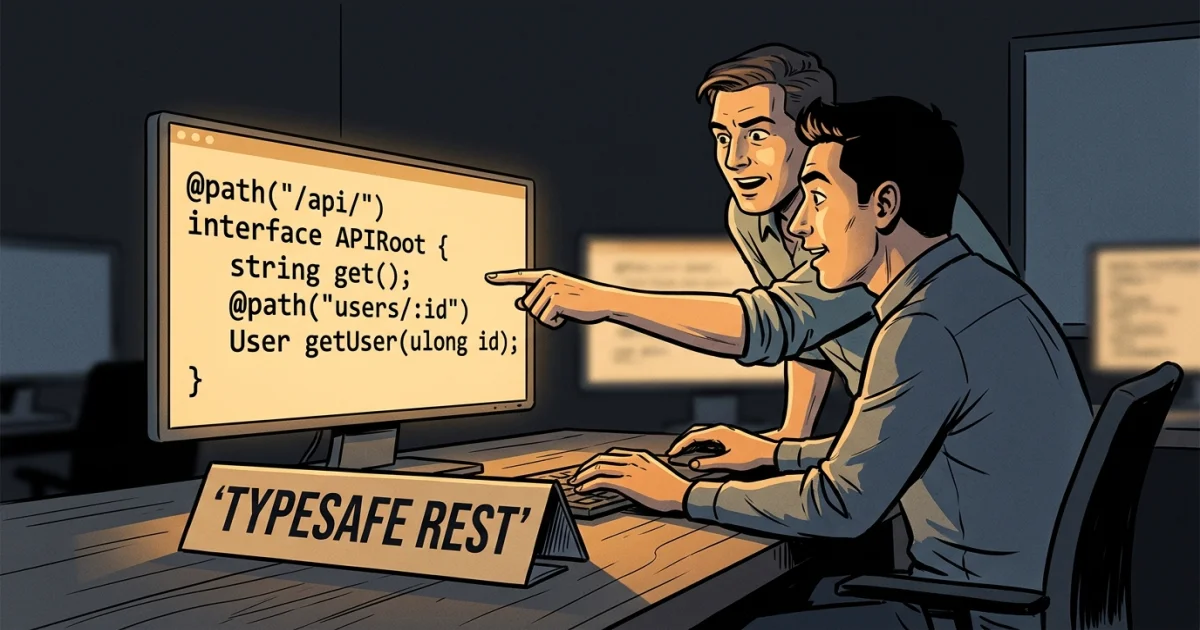
In web/vibe/web/rest.d, Vibe.d pioneered a zero-reflection approach:
@path("/api/")
interface APIRoot {
    string get();

    @path("users/:id")
    User getUser(ulong id);
}
By passing APIRoot to router.registerRestInterface(new ServiceImpl), Vibe.d uses compile-time introspection (__traits and std.traits) to:
- Inspect every member function of the interface.
- Generate HTTP routes based on function names and parameter types (
get()→GET /api/,getUser(ulong id)→GET /api/users/:id). - Synthesize request body deserialization from wire JSON into D structs.
- Serialize return values into JSON responses with proper HTTP status codes.
Crucially, the exact same interface can be instantiated on the client side:
auto client = new RestInterfaceClient!APIRoot("http://api.example.com");
User u = client.getUser(42);
The client proxy translates the function call into an outgoing HTTP request, awaits the response asynchronously on a fiber, and returns the deserialized User struct. Because the server implementation and client proxy share the exact same D interface, route or type mismatches are caught at compile time.
Clone Analysis and Test Boilerplate
We executed prod-code duplicates to detect structural cloning across the repository:
$ prod-code duplicates --min-lines 6 --max-groups 5
⚡ prod-code Clone & Duplication Harvester Report
────────────────────────────────────────────────────
Files Scanned: 108 | Lines: 30151 | Clone Groups: 5 | Duplication: 1.2%

Discovered Clone Groups:

[Clone Group #556] 6 lines | 7 occurrences (Type-2 (Parameterized))
  • web/vibe/web/web.d:292-297
  • web/vibe/web/web.d:426-431
  • web/vibe/web/web.d:464-469
  • web/vibe/web/web.d:506-511
  • web/vibe/web/web.d:556-561
  Preview:
    │     auto router = new URLRouter;
    │     router.registerWebInterface(new WebService);
    │     auto settings = new HTTPServerSettings;
    │     settings.port = 8080;
    │     listenHTTP(settings, router);
Overall duplication across 30,151 lines is low at 1.2%. The primary clone cluster (#556) appears in web/vibe/web/web.d, where documentation examples and unit tests repeatedly set up minimal HTTP routers to verify web interface routing semantics.
The core communication engines in mongodb/, redis/, and web/vibe/web/rest.d are clean and highly consolidated.
Semantic Invariants: 1,390 Invariant Assertions
Asynchronous wire protocols require vigilant boundary verification to guard against packet truncation, malformed BSON frames, and buffer overruns:
$ prod-code struct-search 'assert($A)'
⚡ prod-code Structural AST Search: `assert($A)`
────────────────────────────────────────────────────
1390 match(es) in 52 file(s) (108 scanned in 42.18ms)
The search found 1,390 lines matching assert( across 52 files. This is a syntactic line count, not a count of assertion constructs or evidence that production protocol checks guard socket writes; the behavior of these assertions depends on the build mode. The captured search does not establish a production guarantee.
The evaluation shows how Vibe.d harnesses D’s compile-time traits to deliver high-throughput, fiber-based web architectures with declarative, type-safe API generation.
Cite this article
Alexander Panasenko (2026-10-04). Vibe.d Under the Microscope: What 67 Remote AST Tools Found Inside the D Asynchronous Web Framework. https://prod.codes/blog/vibed-under-the-microscope-67-ast-tools/