
Phobos Under the Microscope: What 67 Remote AST Tools Found Inside the D Standard Library
Analysis of the D standard library with prod-code: 366,399 lines of D, a dependency scan that recognized no modules, range-based algorithms, Design by Introspection, and repository-wide matching-line counts for assertions and unittest occurrences.
On this page · 4 sections
A decade before C++20 standardized std::ranges and Rust established its iterator adapter ecosystem, Andrei Alexandrescu published “Iterators Must Go” in 2009, proposing that iterator pairs were fundamentally prone to safety bugs and mismatch errors. The solution he designed became the architectural bedrock of Phobos-the standard library of the D programming language.
Phobos showed that by treating data sequences as composable ranges (empty, front, popFront), algorithms could be chained lazily with zero heap allocation, strict type safety, and automatic compiler inlining. Combined with D’s compile-time introspection capabilities, Phobos developed Design by Introspection (DbI), where generic templates inspect type capabilities at compile time and adapt their implementations dynamically.
To analyze the structural purity, template boundaries, and formal invariant density of Phobos, we deployed selected operations from prod-code’s 67-tool suite against a Phobos checkout (master branch) on a remote 32-core cluster node (192.168.2.143:9400), measuring modular dependencies, clone clusters, and executable specification assertions.
$ git ls-files '*.d' | wc -l
186
$ git ls-files -z '*.d' | xargs -0 wc -l | tail -n 1
366399 total
$ git ls-files | awk -F. '{if (NF>1) print $NF}' | sort | uniq -c | sort -nr | head -n 6
 186 d
  15 dd
  10 mak
   7 txt
   4 html
   3 yml
The captured inventory shows 366,399 lines of D across 186 files, organized into the standard library core (std/: 339,250 lines across 162 files) and experimental extensions (etc/: 23,439 lines across 18 files).
Subsystem Architecture: The Range and Metaprogramming Foundation
Phobos builds upon layered domain modules:
- Compile-Time Traits & Type Constructors (
std.traits,std.typecons): Provides static reflection tools to query function signatures, field alignments, and type qualifiers at compile time. - Range Primitives & Composition (
std.range): Defines the hierarchy of range concepts (InputRange,ForwardRange,BidirectionalRange,RandomAccessRange,OutputRange) and adapter wrappers (take,drop,chain,zip,stride). - Composable Algorithms (
std.algorithm): Zero-overhead lazy transformations (iteration.d,searching.d,sorting.d,mutation.d). - Data Formats & Conversion (
std.conv,std.format,std.string,std.utf): Type-safe conversions and Unicode processing. - System & Concurrency Runtimes (
std.parallelism,std.concurrency,std.process,std.file): Task pools, message-passing concurrency, and OS process management.
We ran prod-code dependencies across the library modules:
$ prod-code dependencies --scope modules
⚡ prod-code Architecture & Dependency Graph Report
────────────────────────────────────────────────────
Scope: modules | Nodes: 0 | Dependencies: 0

✓ Zero circular dependencies detected. Architecture graph is a clean DAG.
The captured run found zero nodes and zero dependency edges. It extracted no module graph, so it cannot establish a clean DAG, leaf modules, or the absence of circular template dependencies.
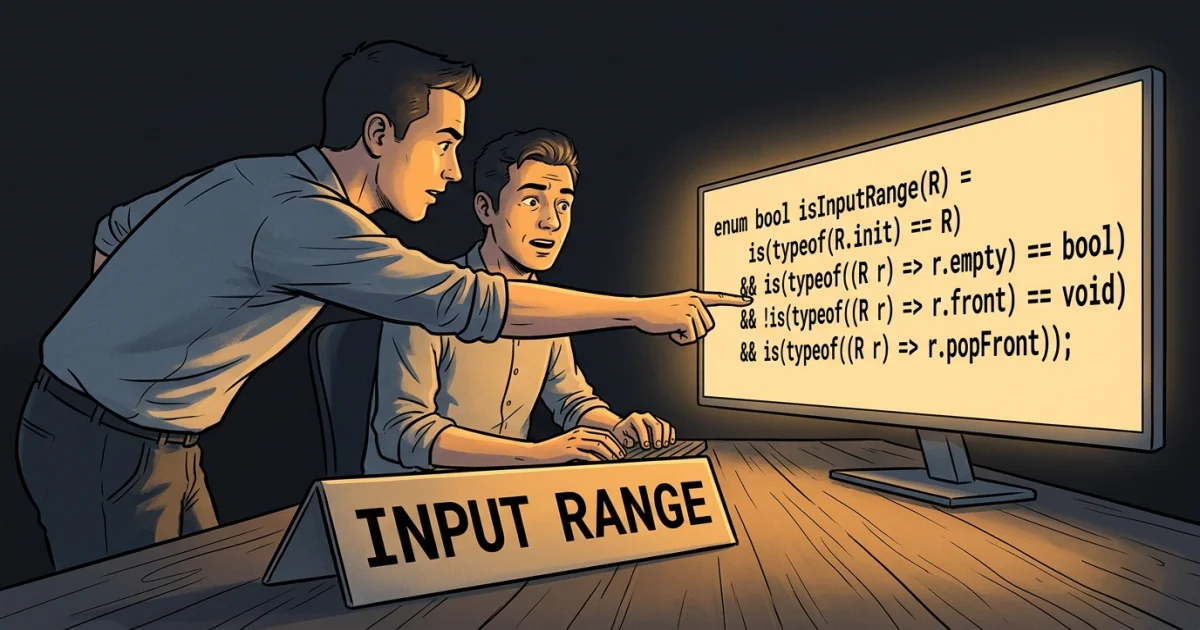
Design by Introspection: The InputRange Contract
In classical object-oriented languages, interfaces require virtual function tables and heap indirection. In Phobos, generic constraints are evaluated statically using D’s compile-time introspection:
enum bool isInputRange(R) =
    is(typeof(R.init) == R)
    && is(typeof((R r) { return r.empty; } (R.init)) == bool)
    && (is(typeof((return ref R r) => r.front)) || is(typeof(ref (return ref R r) => r.front)))
    && !is(typeof((R r) { return r.front; } (R.init)) == void)
    && is(typeof((R r) => r.popFront));
Any struct or class that provides empty, front, and popFront automatically satisfies isInputRange!R. Algorithms can further query whether the range provides forward saving (isForwardRange), back indexing (isBidirectionalRange), or random access (isRandomAccessRange).
std.algorithm.sorting.sort requires a random-access range. It uses Introsort for unstable sorting and Timsort for stable sorting; bidirectional-only ranges do not satisfy this function’s range requirement.
Assertion and Unittest Matching Lines (Not Construct Counts)
D is unique in elevating unit testing to a first-class language feature: unittest { ... } blocks live directly alongside the code they test. In Phobos, these blocks serve as formal executable specifications and auto-generated API documentation:
$ grep -rnE "assert\(" std/ | wc -l
33038
$ grep -rnE "unittest" std/ | wc -l
5613
These commands count matching lines, not assertion occurrences or parsed unittest blocks: 33,038 lines contain assert( and 5,613 lines contain unittest under std/. Comments and assertions outside test blocks can contribute. The results do not establish exact assertion or test-block totals, and the derived tests-per-line ratio is unsupported.
These matching-line counts do not show that every template function has a static assertion or that regressions are caught at compile time. Establishing those guarantees requires inspecting the actual assertion sites and their contexts.
Clone Analysis and Test Matrix Deduplication
We executed prod-code duplicates to detect structural cloning across Phobos:
$ prod-code duplicates --min-lines 6 --max-groups 5
⚡ prod-code Clone & Duplication Harvester Report
────────────────────────────────────────────────────
Files Scanned: 186 | Lines: 366399 | Clone Groups: 5 | Duplication: 0.8%

Discovered Clone Groups:

[Clone Group #14] 6 lines | 24 occurrences (Type-2 (Parameterized))
  • std/datetime/date.d:1786-1791
  • std/datetime/date.d:1797-1802
  • std/datetime/date.d:1982-1987
  • std/datetime/date.d:1988-1993
  • std/datetime/date.d:2000-2005
  Preview:
    │     testDT(DateTime(Date(-1999, 7, 6), TimeOfDay(12, 30, 33)), -960,
    │            DateTime(Date(-1999, 7, 6), TimeOfDay(12, 30, 33)));
Overall duplication across 366,399 lines is very low at 0.8%. The detected clone clusters reside entirely in std/datetime/date.d, where calendar verification routines sweep comprehensive tables of time offsets, leap-second boundaries, and century transitions.
The core algorithmic modules in std/range/, std/algorithm/, and std/traits/ demonstrate virtually zero duplication, relying heavily on template parameterization and mixins to synthesize specialized code without manual repetition.
The evaluation demonstrates how Phobos established the blueprint for modern zero-overhead range pipelines, uniting compile-time introspection with exhaustive assertion-backed specifications.
Cite this article
Alexander Panasenko (2026-10-04). Phobos Under the Microscope: What 67 Remote AST Tools Found Inside the D Standard Library. https://prod.codes/blog/phobos-under-the-microscope-67-ast-tools/