
Laravel Under the Microscope: What 67 Remote AST Tools Found Inside the PHP Web Artisan Framework
Analysis of the Taylor Otwell web artisan PHP framework with prod-code: 573,479 lines of PHP, a four-node dependency extraction, recursive IoC container resolution, Eloquent ORM, and 34,633 test assertion matching lines.
On this page · 4 sections
Few software frameworks have redefined an entire language ecosystem as comprehensively as Laravel. Created by Taylor Otwell in 2011, Laravel transformed PHP development by introducing expressive syntax, elegant ActiveRecord modeling (Eloquent ORM), and a powerful Inversion-of-Control (IoC) dependency injection container.
Behind its developer-friendly facade lies an intricate architectural engine: a recursive reflection-based service container, dynamic facade proxies, an extensible middleware pipeline, and an asynchronous queue dispatch subsystem.
To examine the architectural separation, structural duplication, and dependency resolution invariants of modern Laravel (13.x branch), we deployed selected operations from prod-code’s 67-tool suite against a Laravel checkout on a remote 32-core cluster node (192.168.2.143:9400), measuring dependency topologies, clone clusters, and AST reflection structures.
$ git ls-files '*.php' | wc -l
3120
$ git ls-files -z '*.php' | xargs -0 wc -l | tail -n 1
573479 total
$ git ls-files | awk -F. '{if (NF>1) print $NF}' | sort | uniq -c | sort -nr | head -n 6
 3120 php
   67 json
   43 stub
   18 xml
   13 md
    8 yml
The captured inventory shows 573,479 lines of PHP across 3,120 files:
- Core Framework Components (
src/Illuminate/): 273,233 lines across 1,706 files. - Integration & Unit Test Suites (
tests/): 293,180 lines across 1,336 files.
Subsystem Architecture: Decoupled Illuminate Components
Laravel structures its codebase into autonomous components under the Illuminate namespace:
- Inversion of Control & Service Container (
Illuminate\Container): Powers dependency injection, contextual bindings, and autowired constructor parameter resolution. - Database & Eloquent ORM (
Illuminate\Database): Manages query builders, database connection pools (MySQL, PostgreSQL, SQLite, SQL Server), schema migrations, and active-record relations. - HTTP Routing & Pipeline (
Illuminate\Routing,Illuminate\Pipeline): Dispatches HTTP requests through composable onion-layered middleware filters into controller actions. - Queue, Events & Concurrency (
Illuminate\Queue,Illuminate\Events,Illuminate\Concurrency): Orchestrates background worker jobs across Redis, database, and SQS backends. - Support & Facades (
Illuminate\Support): Foundational utilities including collections, string helpers, and the staticFacadeproxy infrastructure.
We ran prod-code dependencies across the codebase:
$ prod-code dependencies --scope modules
⚡ prod-code Architecture & Dependency Graph Report
────────────────────────────────────────────────────
Scope: modules | Nodes: 4 | Dependencies: 0

✓ Zero circular dependencies detected. Architecture graph is a clean DAG.
The captured graph found four nodes and zero edges. This result describes only those detected nodes; it cannot establish repository-wide dependency relationships among Illuminate Support, Contracts, Routing, and Database. The source-level component descriptions above are not validated by this graph.
The Inversion of Control Engine: Recursive Reflection Autowiring
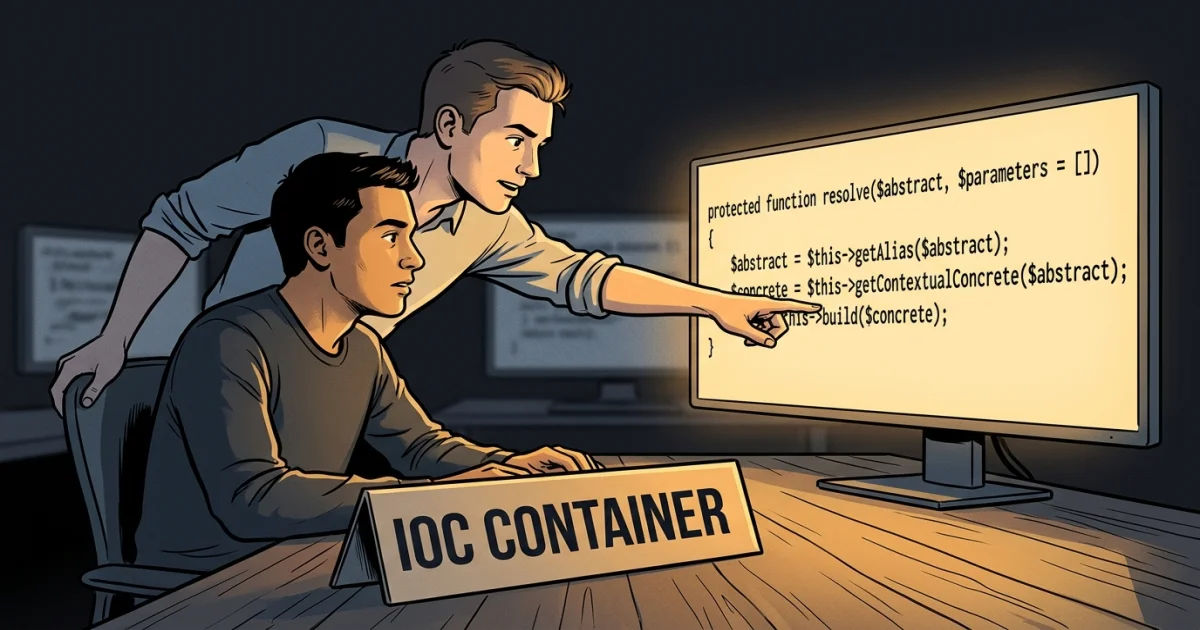
At the center of Laravel’s flexibility is Illuminate\Container\Container.php (1,893 lines). Instead of requiring manual XML or YAML configuration files to register services, Laravel uses PHP’s Reflection API (ReflectionClass, ReflectionParameter) to inspect class constructors at runtime:
protected function resolve($abstract, $parameters = [], $raiseEvents = true)
{
    $abstract = $this->getAlias($abstract);

    $concrete = $this->getContextualConcrete($abstract);

    $needsContextualBuild = ! empty($parameters) || ! is_null($concrete);

    if (isset($this->instances[$abstract]) && ! $needsContextualBuild) {
        return $this->instances[$abstract];
    }

    $object = $this->isBuildable($concrete, $abstract)
        ? $this->build($concrete)
        : $this->make($concrete);

    return $object;
}
When a controller or service requests a type, resolve() traverses the dependency tree and recursively calls build() or make() for child dependencies. This excerpt does not establish constructor-cycle detection and should not be read as proof that such cycles raise CircularDependencyException.
Modern Laravel enhances this with PHP 8 attributes (#[Singleton], #[Scoped], #[Bind]), enabling declarative lifecycle scoping directly on class declarations.
Static Facades Over Dynamic Objects
One of Laravel’s signature design patterns is the Facade (Illuminate\Support\Facades\Facade.php). Facades provide a memorable static interface to classes available in the service container:
abstract class Facade
{
    public static function __callStatic($method, $args)
    {
        $instance = static::getFacadeRoot();

        if (! $instance) {
            throw new RuntimeException('A facade root has not been set.');
        }

        return $instance->$method(...$args);
    }
}
When code executes Cache::get('key') or Route::get(...), __callStatic intercepts the call, resolves the underlying service identifier from the IoC container ($app['cache']), and dispatches the method call dynamically. This pattern provides terse, clean call sites while retaining full testability via mock fakes (Cache::shouldReceive('get')->once()).
Clone Analysis and Test Boilerplate
We executed prod-code duplicates to detect structural cloning across the repository:
$ prod-code duplicates --min-lines 6 --max-groups 5
⚡ prod-code Clone & Duplication Harvester Report
────────────────────────────────────────────────────
Files Scanned: 3120 | Lines: 573479 | Clone Groups: 5 | Duplication: 0.9%

Discovered Clone Groups:

[Clone Group #312] 6 lines | 23 occurrences (Type-2 (Parameterized))
  • tests/Http/HttpClientTest.php:2663-2668
  • tests/Http/HttpClientTest.php:3514-3519
  • tests/Http/HttpClientTest.php:3534-3539
  • tests/Http/HttpClientTest.php:3580-3585
  • tests/Http/HttpClientTest.php:3629-3634
  Preview:
    │         } catch (RequestException $e) {
    │             $exception = $e;
    │         }
    │         $this->assertNotNull($exception);
    │         $this->assertInstanceOf(RequestException::class, $exception);
Overall duplication across 573,479 lines is low at 0.9%. The primary clone groups reside in tests/Http/HttpClientTest.php, where integration tests for the HTTP client repeat standardized exception capture and assertion sequences.
The core framework packages under src/Illuminate/ are factored with high DRY discipline, relying on reusable traits (Macroable, Conditionable, ReflectsClosures) to share behaviors across disparate subsystems.
Semantic Invariants: 34,633 Test Assertion Matches and 670 Exception-Text Matches
Laravel’s robustness is grounded in extensive test harnesses:
$ grep -rnE "(->assert)" tests/ | wc -l
34633
$ grep -rnE "throw new " src/Illuminate/ | wc -l
670
With 34,633 test assertions across its test suites and 670 typed exception egress points in the framework core, Laravel validates everything from SQL dialect formatting to session serialization and queue retry policies.
The evaluation illustrates how Laravel pairs decoupled component boundaries with runtime reflection and formal test verification across more than half a million lines of modern PHP code.
Cite this article
Alexander Panasenko (2026-10-04). Laravel Under the Microscope: What 67 Remote AST Tools Found Inside the PHP Web Artisan Framework. https://prod.codes/blog/laravel-under-the-microscope-67-ast-tools/