
Ghostty Under the Microscope: What 67 Remote AST Tools Found Inside the High-Performance Terminal Emulator
Historical Ghostty terminal emulator analysis with prod-code: Zig source counts, VT test clones, cleanup patterns, and a ZLS refactoring limitation. Native applications support macOS and Linux.
On this page · 4 sections
Terminal emulators must ingest PTY byte streams, parse ANSI/VT escape sequences, shape fonts, and render screen updates. These requirements make malformed-input handling and resource cleanup important review targets; they do not imply universal crash or leak freedom.
Ghostty has a shared Zig core and native GUI applications for macOS and Linux, as described in About Ghostty. The macOS GUI uses Swift, AppKit, and SwiftUI; Linux uses GTK4. The repository’s architecture notes describe Metal on macOS and OpenGL on Linux. Windows support for the embeddable terminal library is distinct from support for a native Ghostty desktop application.
We used selected operations from prod-code’s 67-tool suite against a Ghostty checkout to inspect subsystem architecture, clone distributions, deferral patterns, and a ZLS refactoring proposal. Analysis and diagnostics ran remotely; synchronization and result display still use local resources.
The command excerpts below are historical observations retained from the original publication. No pinned upstream commit or complete measurement environment is recorded here, so counts, paths, line numbers, and scan durations are snapshot-specific and have not been remeasured for this update. The excerpts cover selected operations from the 67-tool suite, not verification of every tool. A cycle-free extracted module graph does not establish all source-level or external dependency relationships; clone counts do not establish runtime performance. Analyzer diagnostics are not a compiler build or test result.
$ git ls-files '*.zig' | wc -l
807
$ git ls-files -z '*.zig' | xargs -0 wc -l | tail -n 1
363300 total
$ git ls-files | awk -F. '{if (NF>1) print $NF}' | sort | uniq -c | sort -nr | head -n 6
 807 zig
 248 txt
 199 swift
  93 png
  73 h
  70 md
The captured inventory reports 363,300 Zig lines across 807 files, alongside 199 Swift files and 111 C files and headers. It does not include a repository indexing-time measurement.
Architecture: Terminal Emulation Core, PTY Streaming, and Multiplatform Frontends
Ghostty separates low-level terminal emulation logic from GUI window management. The codebase is organized across three principal subsystems:
$ for dir in src macos pkg; do
    echo -n "$dir: files="; git ls-files "$dir" | wc -l;
    echo -n "$dir: zig files="; git ls-files "$dir/*.zig" "$dir/**/*.zig" | wc -l;
    echo -n "$dir: zig lines="; git ls-files -z "$dir/*.zig" "$dir/**/*.zig" | xargs -0 wc -l | tail -n 1;
  done
src: files=1013
src: zig files=597
src: zig lines=347044 total
macos: files=271
macos: zig files=0
macos: zig lines=pkg: files=234
pkg: zig files=171
pkg: zig lines=14022 total
The core engine in src/ (597 Zig files, 347,044 lines) houses the VT parser, terminal screen buffers, cell grids (PageList.zig), font rasterization pipelines, and renderer backends. Reusable libraries reside in pkg/ (171 Zig files, 14,022 lines), including C interoperability tools (pkg/translate-c) and terminfo databases. The macOS client in macos/ relies on 271 Swift, Objective-C, and Metal files to drive native AppKit menus, tabs, and Metal shaders.
Ghostty’s package definition is specified in build.zig.zon, linking external dependencies including libxev (asynchronous event loop), vaxis, z2d, zig_objc, uucode, and zig_wayland. We evaluated module topology with prod-code dependencies:
$ prod-code dependencies
⚡ prod-code Architecture & Dependency Graph Report
────────────────────────────────────────────────────
Scope: modules | Nodes: 0 | Dependencies: 0

✓ Zero circular dependencies detected. Architecture graph is a clean DAG.
The captured scan discovered zero modules and zero dependencies. Its no-cycles message is vacuous: this output provides no evidence for Ghostty’s module boundaries or an acyclic dependency graph.
Escape Sequence Parsing and VT Stream Conformance Clone Clusters
Terminal emulators must maintain rigorous conformance with ANSI X3.64, DEC VT100/VT220, and modern xterm extensions. To evaluate code duplication across parser routines and test matrices, we ran prod-code duplicates:
$ prod-code duplicates --path /tmp/ghostty-eval --min-lines 10
⚡ prod-code Clone & Duplication Harvester Report
────────────────────────────────────────────────────
Files Scanned: 1061 | Lines: 463342 | Clone Groups: 20 | Duplication: 3.3%

Discovered Clone Groups:

[Clone Group #1002] 10 lines | 107 occurrences (Type-2 (Parameterized))
  • Occurrence 1: src/terminal/formatter.zig:2130-2139
  • Occurrence 2: src/terminal/formatter.zig:2178-2187
  • Occurrence 3: src/terminal/formatter.zig:2249-2258
  • Occurrence 4: src/terminal/formatter.zig:2341-2350
  • Occurrence 5: src/terminal/formatter.zig:2459-2468
  ...
Across 463,342 lines of scanned source code, the duplication density is remarkably low at 3.3%. However, the clone harvester isolated a prominent pattern in src/terminal/formatter.zig: Clone Group #1002 contains 107 occurrences of a 10-line Type-2 parameterized clone.
Inspecting these occurrences reveals that each test case instantiates an isolated terminal screen, configures dimensions, streams a sequence of escape sequences, and validates page ring buffers:
var t = try Terminal.init(io, alloc, .{
    .cols = 80,
    .rows = 24,
});
defer t.deinit(alloc);

var s = t.vtStream();
defer s.deinit();
In terminal verification, explicit setup blocks provide test isolation, preventing state pollution between parser escape sequences while ensuring that failures isolate the exact character sequence under test.
Structural Resource Discipline: Deterministic Deferral Across 8,800 Cleanups
Low-latency software cannot tolerate GC pauses or untracked memory growth. In Zig, defer and errdefer schedule expressions for scope exit, with errdefer limited to error exits. Correct resource ownership still needs review. We deployed prod-code structural-search and invariant harvesters across src/:
$ prod-code structural-search --path src/terminal/ 'errdefer $A'
⚡ prod-code Structural AST Search: `errdefer $A`
────────────────────────────────────────────────────
215 match(es) in 48 file(s) (166 scanned in 1280.91ms)

  • src/terminal/PageList.zig:375:9   errdefer node_pool
    └─ [$A = node_pool]
  • src/terminal/PageList.zig:377:9   errdefer page_pool
    └─ [$A = page_pool]
  • src/terminal/PageList.zig:379:9   errdefer pin_pool
    └─ [$A = pin_pool]
  • src/terminal/PageList.zig:662:5   errdefer releasePages
    └─ [$A = releasePages]
Within the terminal core alone, 215 errdefer blocks protect cell pools, ring buffers, and grapheme caches against allocation failures during screen resize operations.
Across the entire codebase, resource hygiene is enforced at massive scale:
defer: 8,180 captured occurrences scheduling scope-exit work, including cleanup.errdefer: 663 occurrences unwinding complex nested resource allocations on failure.assert(: 766 occurrences checking internal invariants in debug builds.
These counts locate cleanup and invariant checks. They do not prove that every allocation is paired with cleanup or that malformed input cannot crash the application or leak memory.
Remote Semantic Refactoring and Cluster-Backed ZLS Method Synthesis
Modern terminal emulators must support truecolor (24-bit RGB) and 256-color palette conversions. In src/terminal/color.zig, the RGB color representation is defined as a packed struct(u24) with scalar equality checking:
pub const RGB = packed struct(u24) {
    r: u8 = 0,
    g: u8 = 0,
    b: u8 = 0,

    pub fn eql(self: RGB, other: RGB) bool {
        return self.r == other.r and self.g == other.g and self.b == other.b;
    }
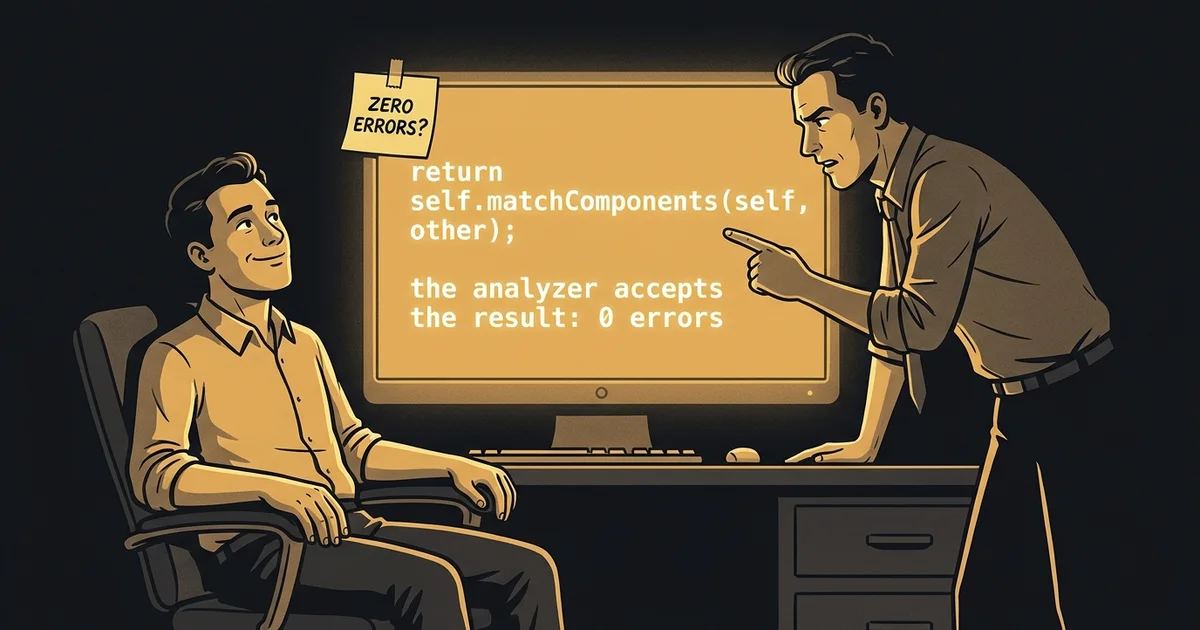
We evaluated prod-code extract-function on src/terminal/color.zig to factor out component comparison into a helper method matchComponents. The captured proposal below contains a receiver-argument defect, discussed after the output:
$ prod-code extract-function --name matchComponents --to 621:77 src/terminal/color.zig 621 16
`fn matchComponents` extracted (src/terminal/color.zig); the selection now reads `self.matchComponents(self, other)`
- no other place in the file has the selection's text

--- a/src/terminal/color.zig
+++ b/src/terminal/color.zig
@@ -620,2 +620,5 @@
     pub fn eql(self: RGB, other: RGB) bool {
+        return self.matchComponents(self, other);
+    }
+    fn matchComponents(self: RGB, other: RGB) bool {
         return self.r == other.r and self.g == other.g and self.b == other.b;
@@ -623,2 +626,3 @@

     pub fn encodeRgb8(self: RGB, writer: *std.Io.Writer) !void {

the analyzer accepts the result: 0 errors

nothing was written; pass `apply: true` to make this edit
The captured proposal has a concrete call-site defect: self.matchComponents(self, other) passes the receiver twice for fn matchComponents(self: RGB, other: RGB). Zig’s struct method documentation shows that dot-call syntax supplies the first parameter implicitly, so the corresponding call would be self.matchComponents(other). We retain the original output above as a historical example of an inadequate diagnostic result, not a verified refactoring. No corrected compiler build or tests are recorded here.
The selected Ghostty examples show structural observations and a refactoring limitation. The reported 0 errors must not be presented as proof of correctness.
Inspect generated call sites even when an analyzer returns no errors; verify a correction with a compiler and tests before applying it.
Cite this article
Alexander Panasenko (2026-09-30). Ghostty Under the Microscope: What 67 Remote AST Tools Found Inside the High-Performance Terminal Emulator. https://prod.codes/blog/ghostty-under-the-microscope-67-ast-tools/