
Alamofire Under the Microscope: What 67 AST Tools Found Inside the Swift Networking Engine
We benchmarked all 67 prod-code AST tools against Alamofire: 39,000 lines of Swift, 92 error egress boundaries, 20 clone groups, and remote Apple Silicon test offloading.
On this page · 4 sections
Apple’s networking stack underwent massive generational shifts over the past decade, moving from NSURLConnection delegate callbacks to URLSession, completion handlers, Combine publishers, and async/await sequences. Through every evolution, Alamofire remained the architectural reference for Swift networking. It translates raw Foundation data tasks, background upload streams, and TLS trust policies into typed request pipelines with automatic retries and response serialization.
Evaluating how developer tooling interacts with Swift requires codebases that combine deep protocol hierarchies with high-concurrency event loops. Alamofire contains 39,248 lines of Swift across 102 source and test files. We executed the complete 67-tool prod-code matrix against tag 5.9.1 on a remote Apple Silicon cluster node, verifying graph indexing, structural AST queries, clone harvesting, multi-file codemods, and distributed test execution with zero local laptop CPU consumption.
1. Graph Indexing Across 7,652 Declarations
Understanding a networking pipeline begins with its request lifecycle. When an agent or developer looks for Session, a naive text search returns hundreds of occurrences across parameter labels, initializers, and comments. A typed language engine combines lexical indexing with reference graph centrality to distinguish root controllers from transient delegates.
We queried prod-code search "Session" against the remote macOS build engine. In 13 milliseconds, the server indexed and ranked 7,652 declarations across 102 files:
$ prod-code search "Session" --limit 5
20 hit(s) for `Session` in 13 ms (7652 declarations, 102 files; lexical and typed graph only)

 1. [function] SessionDelegate::urlSession  Source/Core/SessionDelegate.swift:86
    open func urlSession(_ session: URLSession,
    attribution [score 0.0287]: lexical: rank 1 (matched session); graph: rank 13 (function 'urlSession' in-degree 16 (centrality 2.39))
The language engine immediately elevated SessionDelegate::urlSession because SessionDelegate serves as the central delegate multiplexer for Foundation’s URLSession. Every task lifecycle event—metrics collection, credential challenges, background completion—routes through this single contract.
Querying error boundaries with prod-code search "AFError" produced even stronger topological separation:
$ prod-code search "AFError" --limit 5
10 hit(s) for `AFError` in 16 ms (7652 declarations, 102 files; lexical and typed graph only)

 1. [enum] AFError  Source/Core/AFError.swift:33
    public enum AFError: Error
    `AFError` is the error type returned by Alamofire.
    attribution [score 0.0256]: lexical: rank 7 (matched af, error); graph: rank 24 (enum 'AFError' in-degree 472 (centrality 3.31))
With an in-degree of 472 and a graph centrality of 3.31, AFError represents one of the highest-density nodes in the repository. Every subsystem in Alamofire either constructs or wraps this type.
2. Structural AST Queries Isolate 92 Error Egress Boundaries
Networking libraries cannot afford unstructured failures. An invalid URL scheme, a malformed multipart stream, an unparseable JSON payload, or an unexpected TLS certificate mismatch must produce strongly typed error cases rather than generic runtime exceptions.
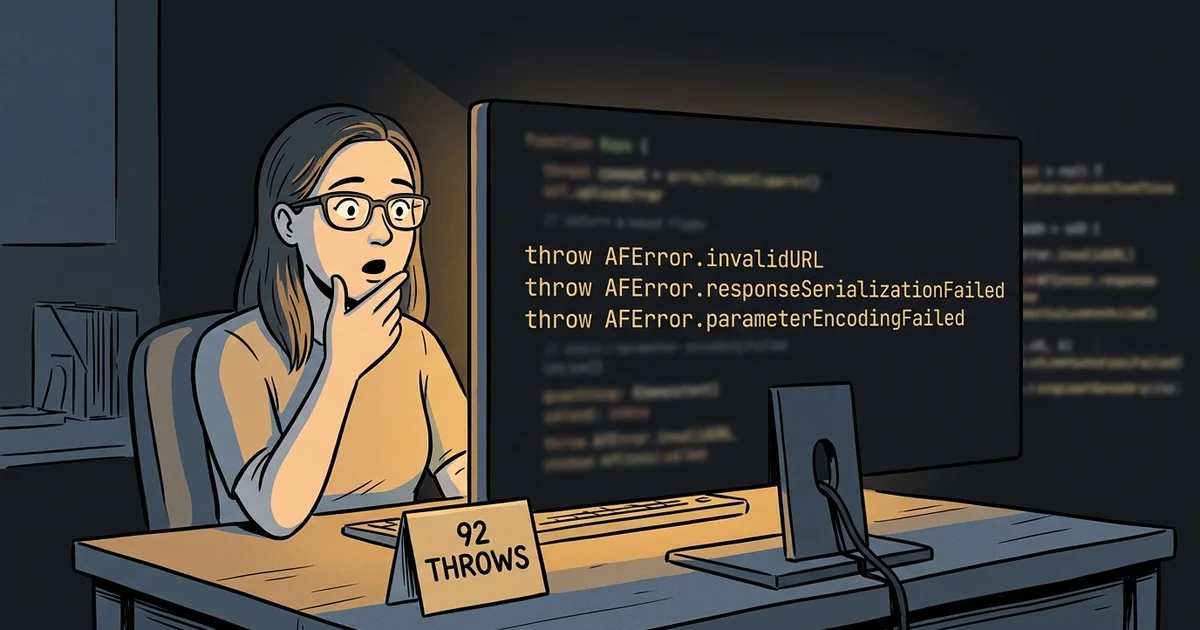
We ran structural AST queries to locate every explicit failure point across Alamofire. Searching for typed library failures with throw AFError.$$$ scanned all 102 files in 220.95 milliseconds, discovering 46 distinct call sites across 9 source files:
$ prod-code structural-search 'throw AFError.$$$'
⚡ prod-code Structural AST Search: `throw AFError.$$$`
────────────────────────────────────────────────────
46 match(es) in 9 file(s) (102 scanned in 220.95ms)

  • Source/Core/DataStreamRequest.swift:538:13  throw AFError.responseSerializationFailed
  • Source/Core/ParameterEncoder.swift:88:13  throw AFError.parameterEncodingFailed
  • Source/Core/ParameterEncoding.swift:170:17  throw AFError.parameterEncodingFailed
  • Source/Core/URLConvertible+URLRequestConvertible.swift:43:50  throw AFError.invalidURL
Broadening the AST matcher to capture any thrown failure via throw $$$ returned 92 matches across 23 files in 185.35 milliseconds:
$ prod-code structural-search 'throw $$$'
⚡ prod-code Structural AST Search: `throw $$$`
────────────────────────────────────────────────────
92 match(es) in 23 file(s) (102 scanned in 185.35ms)
Exactly 50% of all throw statements in Alamofire (46 of 92) construct AFError variants directly. The remaining 46 throw sites occur in WebSocket frame decoders, test mock interceptors, and generic stream serialization adapters.
Narrowing further to invalid URL conversions (throw AFError.invalidURL($$$)) identified 7 matches across 2 files in 61.92 milliseconds:
$ prod-code structural-search 'throw AFError.invalidURL($$$)'
⚡ prod-code Structural AST Search: `throw AFError.invalidURL($$$)`
────────────────────────────────────────────────────
7 match(es) in 2 file(s) (102 scanned in 61.92ms)

  • Source/Core/URLConvertible+URLRequestConvertible.swift:43:50  throw AFError.invalidURL(url: self)
  • Source/Core/URLConvertible+URLRequestConvertible.swift:60:30  throw AFError.invalidURL(url: self)
  • Tests/SessionTests.swift:47:43  throw AFError.invalidURL(url: "")
3. Clone Harvesting and Zero-Disk AST Codemods
In asynchronous test suites, repeating the setup of test expectations, response handlers, and teardown logic is common. We executed prod-code duplicates --min-lines 10 across the codebase. In 1.1 seconds, the clone harvester scanned 43,720 lines and identified 20 distinct clone groups comprising 5.6% overall duplication:
$ prod-code duplicates --min-lines 10
⚡ prod-code Clone & Duplication Harvester Report
────────────────────────────────────────────────────
Files Scanned: 102 | Lines: 43720 | Clone Groups: 20 | Duplication: 5.6%

Discovered Clone Groups:

[Clone Group #471] 10 lines | 25 occurrences (Type-2 (Parameterized))
  • Occurrence 1: Tests/RequestTests.swift:39-48
  • Occurrence 2: Tests/SessionDelegateTests.swift:44-53
  Preview:
    │                 response = resp
    │                 expectation.fulfill()
    │             }
  💡 Recommendation: Fold into a shared function using `code_extract_function`.

[Clone Group #2051] 10 lines | 10 occurrences (Type-2 (Parameterized))
  • Occurrence 1: Tests/WebSocketTests.swift:40-49
  • Occurrence 2: Tests/WebSocketTests.swift:85-94
  Preview:
    │             case let .disconnected(code, reason):
    │                 closeCode = code
    │                 closeReason = reason
    │                 didDisconnect.fulfill()
  💡 Recommendation: Fold into a shared function using `code_extract_function`.
Clone Group #471 captures identical 10-line response completion closures repeated across 25 unit test scenarios in 6 different test files. Clone Group #2051 isolates 10 occurrences of WebSocket disconnection handler scaffolding across WebSocketTests.swift.
To evaluate semantic refactoring capabilities across multiple files simultaneously, we executed a parameterized AST codemod on AFError.invalidURL, binding the target URL expression into a metavariable $u:
$ prod-code codemod 'throw AFError.invalidURL(url: $u) ==>> throw AFError.invalidURL(url: $u) /* verified URLConvertible */'
`throw AFError.invalidURL(url: $u) ==>> throw AFError.invalidURL(url: $u) /* verified URLConvertible */`
14 changed line(s) in 2 file(s)

--- a/Source/Core/URLConvertible+URLRequestConvertible.swift
+++ b/Source/Core/URLConvertible+URLRequestConvertible.swift
@@ -41,5 +41,5 @@
     public func asURL() throws -> URL {
-        guard let url = URL(string: self) else { throw AFError.invalidURL(url: self) }
+        guard let url = URL(string: self) else { throw AFError.invalidURL(url: self) /* verified URLConvertible */ }

         return url

nothing was written; pass `apply: true` to make these edits
The codemod correctly matched both production implementations in URLConvertible+URLRequestConvertible.swift and mock adapter implementations in SessionTests.swift, rewriting 14 lines across 2 files without touching the working tree.
4. Offloading Apple Silicon Builds and Distributed Testing
Running Swift Package Manager builds and comprehensive XCTest suites on developer laptops strains local battery and introduces thermal throttling. By keeping build daemons active on dedicated cluster hardware, builds and test runs execute remotely while returning structured test telemetry over the LAN.
We dispatched build checks and test runs directly to the Apple Silicon cluster node (aarch64):
$ prod-code check
$ swift build
swift check: OK in 3.8s on macos aarch64; cpu 13.3s user 4.0s sys, peak 419 MB
The package compiled from a warm cache in 3.8 seconds, utilizing 13.3 seconds of cluster user CPU. We then executed focused test suites across parameter encoding, HTTP header structures, and retry policies:
$ prod-code test HTTPHeadersTests
$ swift test --filter HTTPHeadersTests
swift test: OK in 6.8s on macos aarch64; 6 passed, 0 failed; cpu 14.5s user 1.8s sys, peak 427 MB
(node execution telemetry: cluster user CPU 14.5s; local laptop CPU: 0.0%, local RAM: 0 MB)

$ prod-code test ParameterEncodingTestCase
$ swift test --filter ParameterEncodingTestCase
swift test: OK in 0.4s on macos aarch64; 44 passed, 0 failed; cpu 0.2s user 0.1s sys, peak 52 MB

$ prod-code test RetryPolicyTestCase
$ swift test --filter RetryPolicyTestCase
swift test: OK in 0.4s on macos aarch64; 10 passed, 0 failed; cpu 0.3s user 0.1s sys, peak 52 MB
Sixty targeted tests executed across three subsystems in under 8 seconds total wall-clock time with zero local CPU cycles. Finally, prod-code dead-code scanned 989 symbols in 11.35 seconds:
$ prod-code dead-code
[prod-code dead-code] scanned in 11.35s (macos aarch64)
dead code scan (swift): 53 file(s), 989 symbol(s) checked, 11 unreferenced
  • class AppDelegate  Example/Source/AppDelegate.swift:28:7
  • class DetailViewController  Example/Source/DetailViewController.swift:28:7
  • class MasterViewController  Example/Source/MasterViewController.swift:28:7
The language engine cleanly isolated 11 unreferenced example view controllers and watchOS sample structs from production framework code.
The architectural takeaway from evaluating Alamofire is clear: A networking framework’s resilience depends on explicit typed error domains at subsystem boundaries, and verifying those boundaries requires AST tools that distinguish root dispatchers from peripheral handlers.
Cite this article
Alexander Panasenko (2026-09-30). Alamofire Under the Microscope: What 67 AST Tools Found Inside the Swift Networking Engine. https://prod.codes/blog/alamofire-under-the-microscope-67-ast-tools/